A guide for when life gets hard
Trauma & PTSD
When the past won't stay in the past — understanding and healing trauma.
You're not alone in this.
Trauma is not what happened to you — it’s what happened inside you as a result. It lives in the body, shapes the nervous system, and rewrites the story of what is safe. Healing is not about forgetting or “moving on.” It is about integrating the experience so it no longer runs your life from the shadows.
The books and resources here include some of the most important works in trauma science alongside deeply human accounts of recovery.
Your recovery pathway
Five science-backed stages from crisis to thriving
-
01Stabilize Restore safety and calmThis journey
-
02Regulate Manage emotions and energyThis journey
-
03Rebuild Strengthen your foundationsThis journey
-
04Adapt Embrace the new normal
-
05Thrive Create a life you love
Books hand-picked for this journey
Every title below has been chosen because it speaks directly to where you are right now — and where you are going.




Matrescence Made Clear
Becoming a mother is not a crash. It's a becoming. Matrescence, the developmental transfor…

Through the Dark
Grief does not follow a map. Written by Catherine B. Oliver from inside her own worst nigh…
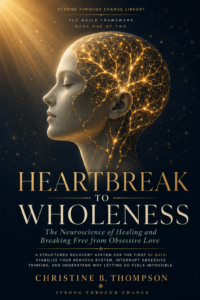
Heartbreak to Wholeness, Volume One: The Neuroscience of Healing and Breaking Free from Obsessive Love
Relationship loss is one of the most acute forms of grief, and one of the least supported.…
Personalised guidance
Discover your personal
resilience profile
The free 5-minute Strong Through Change Assessment reveals exactly which stage of the framework you're in right now — and gives you a tailored reading path to help you move forward.
Insights to guide your journey
Why the Past Won’t Stay There: Understanding Trauma and Beginning to Heal
Trauma is not a story about the past. It is a present-tense experience stored in the body and nervous system — and healing requires working with both.

Questions people ask when facing this challenge
You're not the first to feel this way — and you won't be the last. Here are honest answers to the questions we hear most.
Get personalised guidance →-
Trauma refers to the psychological injury caused by overwhelming events. PTSD (Post-Traumatic Stress Disorder) is a specific clinical condition that develops in some — but not all — trauma survivors, characterised by flashbacks, avoidance, hypervigilance, and negative changes in mood and cognition.
-
Yes — not in the sense of the event being erased, but in the sense that it no longer hijacks your present. Post-traumatic growth is well-documented. Many survivors describe their healing journey as ultimately transforming their relationship with life in profound ways.
-
No — traditional talk therapy alone is often insufficient for trauma, because trauma is stored somatically (in the body). Effective trauma treatment often involves body-based approaches: EMDR, somatic experiencing, sensorimotor therapy. The books in this hub, particularly "The Body Keeps the Score", explain why.
-
Educate yourself on trauma responses (especially triggers, dissociation, and hypervigilance). Don't take these personally. Maintain steady, predictable presence — trauma heals in safe relationships. Encourage professional support, and ensure you have your own support so you don't burn out as a caregiver.