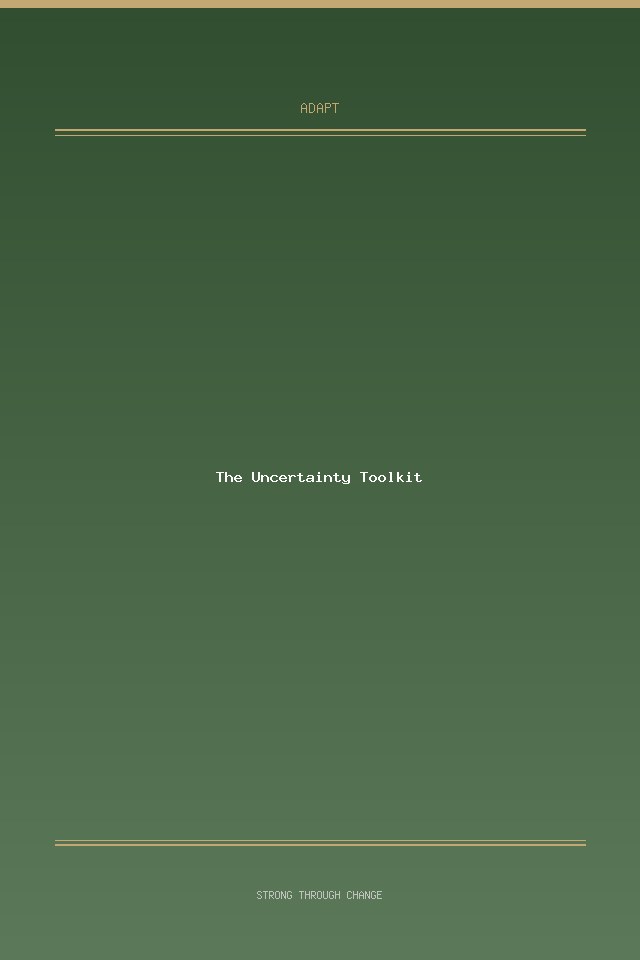
The Uncertainty Toolkit cover

$15.99 USD

Digital Print
Pillar 04 — Adapt

The Uncertainty Toolkit

Practical Strategies for Living and Deciding in a World You Can't Control

by Strong Through Change Editorial Team

Uncertainty is not the enemy — intolerance of uncertainty is. This comprehensive guide teaches you to develop a workable, productive relationship with not-knowing: holding open questions without being paralysed by them.

Who this is for

People suffering primarily from the uncertainty of their situation. Those navigating major life transitions and struggling with not-knowing. Anyone whose primary psychological challenge is intolerance of uncertainty.

About This Book

There is a particular suffering that is not about what has happened but about what might. The rumination. The catastrophising. The endless mental modelling of possible futures. The inability to rest in not-knowing. This is the suffering of uncertainty intolerance — and it is often more painful than the difficult outcomes it is trying to prevent. The Uncertainty Toolkit is a comprehensive guide to developing a genuinely different relationship with not-knowing.

The book begins with the neuroscience and psychology of uncertainty intolerance: why the brain treats unresolved uncertainty as a threat signal, how this operates differently from anxiety about known dangers, and why the standard anxiety-management approaches often make it worse rather than better. This understanding is essential, because the most effective approaches are counterintuitive — they involve turning toward the uncertainty rather than away from it.

The toolkit is organised into four areas. Cognitive flexibility tools address catastrophising and worst-case fixation. Tolerance building practices develop the nervous system's capacity to sit with unresolved situations without alarm. Decision-making under uncertainty provides frameworks for making good decisions with incomplete information. And meaning in uncertainty explores the philosophical and spiritual dimensions of not-knowing — the way that genuine uncertainty, engaged honestly, can become a source of aliveness rather than dread.

A substantial section addresses the specific forms of uncertainty that arise in major life transitions: not knowing who you will be on the other side; not knowing whether you have made the right choices; not knowing how long the difficult period will last. For each, the book offers specific, practical tools drawn from CBT, ACT, stoic philosophy, and contemplative practice.

Framework position

Pillar 04 — Adapt: The uncertainty-focused companion to Flexible Forward. Read when the primary difficulty is not-knowing rather than known challenges.

Buy & get instant download after checkout

Secure checkout · Instant download link sent by email after purchase

Reader Reviews

No reviews yet — be the first to share your thoughts.